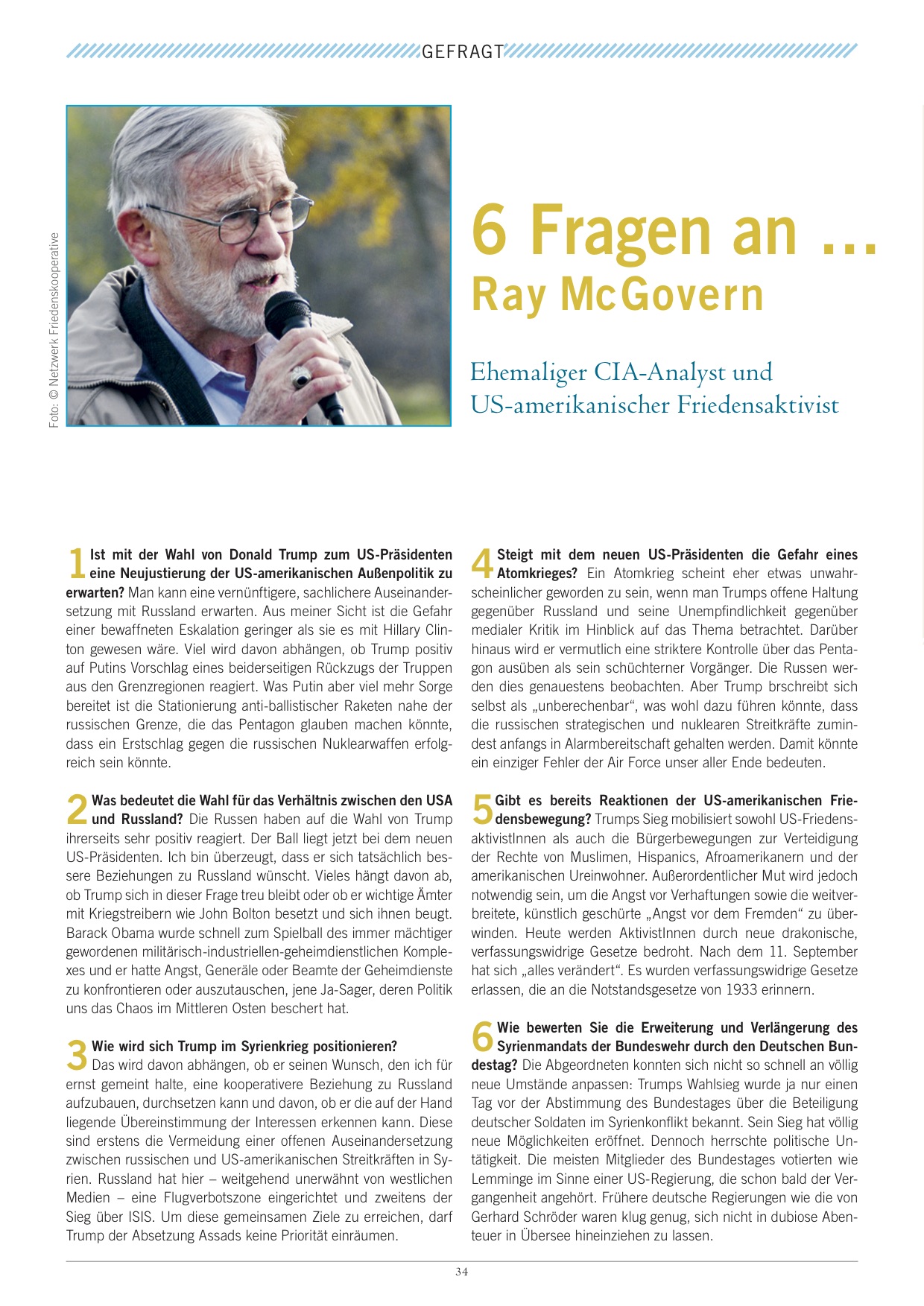
Ray was in Berlin during the U.S. election. There was, of course, immense interest (tinged with considerable shock) regarding what to make of Trump and what his election could mean for Germany and East-West relations. When Ray got back home a week later, he was asked to respond to “Six Questions” for Forum, the main publication of the German affiliate of International Physicians for the Prevention of Nuclear War/Physicians for Social Responsibility, one of the most important peace organizations in Germany. Not surprisingly, the questions home in on issues of most importance to Germany, concerns not discussed very much in the U.S. – yet.
Since no English version will be published, we translated (below) the one-page piece just sent to Ray. Pressed for time, Ray emailed his answers in English on Nov. 17. He has now checked the IPPNW translation. It is accurate. (Actually, the interview sounds a lot better in German!)
For the German speakers, the text in German can be found at the bottom of this post.
++++++++++++++++++++
Ist mit der Wahl von Donald Trump zum US-Präsidenten eine Neujustierung der US-amerikanischen Außenpolitik zu erwarten?
With the election of Donald Trump can one expect an adjustment in U.S. foreign policy?
One can expect a more reasonable, business-like approach to Russia. In my view, the immediate danger of armed escalation is less that would have been the case if Clinton had won. Much will depend on whether Trump reacts in a positive way the Putin’s suggestion of a mutual pullback of troops from the border areas. What worries Putin even more is the stationing of ABM bases around Russia’s periphery, which could lead Pentagon leaders to believe that a first-strike against Russian strategic forces would be successful.
Was bedeutet die Wahl für das Verhältnis zwischen der USA und Russland?
What does the election mean for relations between the U.S. and Russia?
For their part, the Russians have reacted in a very positive way to the election of Trump. The ball is now in Trump’s court. I believe Trump really does want better relations with Russia. Much will depend on whether Trump turns out to be “his own man” or appoints and defers to warmongers like John Bolton in key posts. Barack Obama quickly became putty in the hands of the so-called Deep State — afraid of confronting or replacing the Generals and intelligence officials – the “yes-men” — whose policies brought chaos to the Middle East.
Wie wird sich Trump im Syrienkrieg positionieren?
What will Trump’s position be on war in Syria?
This will depend on whether he can implement his wish (which I believe is genuine) to pursue a more cooperative relationship with Russia – and on whether he can see the clear congruence of interests. Those are: (1) preventing an open clash between Russian and U.S. armed forces over Syria, where Russia has imposed a no-fly zone (a fact virtually ignored in Western media); and (2) defeating ISIS. To act on this convergence of interest, Trump must not give priority to the “first Assad must go” approach.
Steigt mit Trump die Gefahr eines Atomkrieges?
Has the danger of nuclear war increased with Trump?
Nuclear war seems somewhat more remote, given Trump’s open attitude toward Russia and his imperviousness to media criticism on that score. Moreover, he is likely to take more effective control over the Pentagon than his shy predecessor; the Russians will be watching that closely. But Trump’s self-trumpeted “unpredictability” is likely to have Russian strategic forces on high alert, at least initially. Thus, an Air Force mistake could mean the end of all of us.
Gibt es bereits Reaktionen der US-amerikanischen Friedensbewegung?
Are there already reactions in the U.S. peace movement?
Trump’s win is already galvanizing U.S. activists for peace as well as for justice for Muslims, Hispanics, African Americans, and Native Americans. Exceptional courage will be required, though, to overcome the fear of arrest, as well as the widespread, artificially stoked “fear of the other.” After 9/11 “everything changed” – very much like after the burning of the Reichstag in 1933. Activists now face draconian, unconstitutional laws passed after 9/11 – laws reminiscent of the “emergency laws” passed in 1933.
Wie bewerten Sie die Erweiterung und Verlängerung des Syrienmandats der Bundeswehr durch den Deutschen Bundestag?
How do you evaluate the German Bundestag’s vote to widen and prolong the mandate for involvement of German armed forces in Syria?
It is difficult for legislators to adapt quickly to totally new circumstances – like Trump’s victory just one day before the Bundestag voted on participation of German forces in the Syrian conflict. Trump’s victory opened completely new possibilities. Yet, inertia prevailed. Most Bundestag members voted like lemmings to please a U.S. administration soon to be gone. Earlier German governments – like that of Gerhard Schroeder – were wise to avoid being dragged into highly dubious adventures overseas.
November 18, 2016 (8 minutes; the section with Ray starts at minute 3:20)
Basically, the President’s failure to rise to the occasion with a pardon for Snowden can be readily attributed to Obama’s abiding fear of the Deep State and his consequent penchant for looking “ahead.” After all, what might practitioners of the “dark side,” whom he as thus far held harmless, do to him and his family if he changed his mind?
Alternatively, the President’s transparently false claim permits of at least three other – not mutually exclusive – explanations: (1) he actually got his law degree via snail mail correspondence with the “Havard Law School” advertised inside Chicago matchbooks; (2) as professor of constitutional law, he focused exclusively on the constitution of Burkina Faso; and/or (3) he is, once again, taking us for fools.
Trump’s choice for CIA director, Mike Pompeo, is a big fan of torture. On the CIA analysis front, the $64 question is this: Will the two new Mikes – Pompeo and Trump National Security Adviser Mike Flynn – be able to suborn CIA analysts into conjuring up fraudulent intelligence to “justify” an attack on Iran (as their predecessors did with respect to Iraq 14 years ago)? The reality of “potential pre-emptive leaks” can act as a brake on that kind of dishonesty.
Ray was interviewed by Paul Jay of The Real News Network on President-Elect Trump’s naming of Michael Flynn as the National Security Adviser. Flynn is, well, in like Flynn; that key position requires no Senate confirmation.
Later on Thursday, RT International asked Ray to comment:
November 17, 2016, (6 minutes)
Background: At his press briefing on Nov. 16, retired Navy admiral John Kirby had a very bad-hair day; he ended up creating an international incident by his bully behavior toward RT journalist Gayane Chichakyan. She had had the temerity to ask Kirby to provide the sources behind his charge that the Russians and/or Syrians had bombed at least five hospitals in Syria. Kirby was unable to produce the sources.
Instead of routinely promising to seek out and provide the sources to Chichakyan, Kirby simply lost it, blurting out from the podium, “I’m sorry, but I’m not going to put Russia Today on the same level with the rest of you who are representing independent media outlets.” (Emphasis added)
The following day, his opposite number, Russian foreign ministry spokesperson Maria Zakarova, decried Kirby’s unprofessional behavior and threatened to retaliate by segregating American journalists who attend her own briefings.
For those wishing to get a feel for the level to which State Department briefings have descended, we include below a partial transcript. Chichakyan’s part in the Q&A questioning is highlighted in bold.
After Kirby tried to put her in her place, a few of her colleagues defended her. That short section is also included below, together with a summary of Zakharova’s remarks on Nov. 17.
True to form, President Obama the following day added to U.S. embarrassment in trying to explain away Kirby’s indefensible behavior as “overzealousness.” The upshot is further proof that neither a tired, tongue-tied President nor an unprepared, bumbling former admiral do particularly well thinking on their feet – sans teleprompter.
Additional background and partial transcript: At the daily State Department press briefing on November 16, Kirby became extraordinarily flustered, flubbing – inter alia – a series of questions on the International Criminal Court, about which he appeared to know little to nothing. Then came the obligatory blame-the-Russians segment of his briefing. Watching the briefing is even more embarrassing than reading it. But, for those who prefer to read, here’s a partial text —
QUESTION: Okay. First of all, can you clarify what is going on in terms of where the Russians are bombing? I mean, some say in Aleppo, but there is no evidence that there is any bombardment of eastern Aleppo by the Russians. There is bombardments of Idlib and Homs and so on, and the countryside of Homs. So first of all, if you have information on where they are bombing and what is going on there.
MR KIRBY: Well, I don’t have – as you know, Said, I don’t have specific tactical information about Russian military operations … . We – I would say, though, that we have seen additional airstrikes now in Syria by Russia and by the regime, to include what has been reported to be – and we have no reason to doubt this because of the sourcing that we’re getting – that five hospitals and at least one mobile clinic in Syria were struck by —
QUESTION: Can say which city the hospitals were in?
MR KIRBY: What’s that?
QUESTION: Which city were the hospitals in?
MR KIRBY: I don’t have the exact location. But – so five hospitals and one mobile clinic. And by all counts, it looks like they were deliberately targeted, all in the span of just the last day or so. It’s also worth noting that despite Russian claims that it halted airstrikes in the past month or so —
QUESTION: Twenty-eight days.
MR KIRBY: — yeah – they’ve allowed no food or humanitarian assistance into east Aleppo. And the regime and Russia have now let Aleppo’s residents starve, all while seeking praise from the international community for halting indiscriminate strikes for three weeks. Again, five hospitals and at least one – maybe more – mobile clinic. That doesn’t sound to me like a halt in indiscriminate attacks.
QUESTION: Can you give us a specific —
QUESTION: Now the Russians are – excuse me, just let me —
QUESTION: Sorry.
QUESTION: — follow up with a couple of things. The Russian defense ministry claims that it is actually the rebels who are – or the terror groups who are holding back the aid, they are disallowing the public from reaching that humanitarian aid. And in fact, they’re saying that there was some sort of demonstration by the public and that was crushed brutally by the different militant groups and so on. And so I want – how do you sort out after all this kind of conflicting information and so on – how do you get your information on this case?
MR KIRBY: No, look, it’s a very fluid situation and our knowledge is imperfect. That’s why we say I have seen – we’ve seen reports of these things. And I don’t have specifics for you. I don’t have specific locations —
QUESTION: But don’t you think it’s —
MR KIRBY: Hang on a second, I’m answering Said.
QUESTION: Don’t you think it is important —
MR KIRBY: We don’t have that. I’m saying we’ve seen these reports.
QUESTION: Right.
MR KIRBY: And they fly in the face of everything Russia says it’s doing in Syria, and specifically in Aleppo. So I don’t have – I don’t have (inaudible) on this and it wouldn’t be appropriate for me to get into that anyway.
QUESTION: But don’t you think it is important —
QUESTION: So you would refute —
MR KIRBY: But, but —
QUESTION: — the claim by the Russians that they have stopped or they had a moratorium on striking Aleppo, eastern Aleppo, for the past 28 days? In fact, all the while were – the militant groups were striking western Aleppo.
MR KIRBY: So we’ve seen – well, you’ve also seen reports that – about opposition groups that were limiting or trying to be an obstacle to humanitarian aid and assistance. And we’ve made it clear to the opposition groups that we communicate with and certainly to nations who have influence over other opposition groups that these reports are troubling and concerning and obviously to the degree they’re true, that that obstruction should not occur. That said, it’s without question that it is the regime and its Russian backers that have had the – by far, the most responsibility for stopping the violence, for stopping the strikes, and for allowing the aid to get in, which they haven’t done. I mean, I don’t know how many times now I’ve been to this podium talking about the fact that no humanitarian aid is getting into Aleppo and that hasn’t changed.
Question from RT’s Gayane Chichakyan:
QUESTION: Don’t you think it is —
MR KIRBY: It hasn’t changed one bit.
QUESTION: Sorry, don’t you think it is important to give a specific list of hospitals that you’re accusing Russia of hitting? Those are grave accusations.
MR KIRBY: I’m not making those accusations. I’m telling you we’ve seen reports from credible aid organizations that five hospitals and a clinic —
QUESTION: Which hospital —
MR KIRBY: At least one clinic —
QUESTION: In what cities at least?
MR KIRBY: You can go look at the information that many of the Syrian relief agencies are putting out there publicly. We’re getting our information from them too. These reports —
QUESTION: But you are citing those reports without giving any specifics.
MR KIRBY: Because we believe these agencies are credible and because we have other sources of information that back up what we’re seeing from some of these reports. And you know what? Why don’t ask —
QUESTION: If you – exactly.
MR KIRBY: Here’s a good question.
QUESTION: That’s what I —
MR KIRBY: Why don’t you ask your defense ministry —
QUESTION: That’s what I was —
MR KIRBY: — what they’re doing and see if you can get —
QUESTION: If you give a specific list —
MR KIRBY: No, no, no, no, no, no, no.
QUESTION: If you give a specific list of hospitals —
MR KIRBY: No, no, no.
QUESTION: My colleagues who are listening —
MR KIRBY: I’m supposed to —
QUESTION: — hopefully would be able to go and ask Russian officials about a specific list of hospitals that you’re accusing Russia of —
MR KIRBY: You work for Russia Today, right? Isn’t that your agency?
QUESTION: That is correct. Yes.
MR KIRBY: And so why shouldn’t you ask your government the same kinds of questions that you’re standing here asking me?
QUESTION: When you level —
MR KIRBY: Ask them about their military activities. Get them to tell you what they’re – or to deny what they’re doing.
QUESTION: When I ask for specifics, it seems your response is why are you here? Well, you are leveling that accusation.
MR KIRBY: No, ma’am.
QUESTION: And if you give specifics —
MR KIRBY: No, ma’am.
QUESTION: — my colleagues would be able to ask —
MR KIRBY: No, ma’am.
QUESTION: — Russian officials.
MR KIRBY: Once again, you’re just wrong. I’m not leveling those accusations. Relief agencies that we find credible are leveling those accusations.
QUESTION: But you repeat them.
MR KIRBY: So why don’t you question them about their information and where they’re getting it? And why don’t you question your own defense ministry?
QUESTION: Which organizations then? Which ones? Where should I look?
MR KIRBY: We’ll get you – we will get you a list of them after the briefing. I don’t have it right here in front of me, but I’m happy to provide to you some of the relief agencies that are telling us what they’re seeing on the ground.
QUESTION: And specifically on blocking aid within the 28 days that Russia and Syria had stopped the airstrikes in eastern Aleppo, and I understand they resumed by the – they were resumed by the Syrian military yesterday. Do you – can you give any specific information on when Russia or the Syrian Government blocked the UN from delivering aid? Just any specific information.
MR KIRBY: There hasn’t been any aid delivered in the last month.
QUESTION: And you believe it was blocked exclusively by Russia and the Syrian Government.
MR KIRBY: There’s no question in our mind that the obstruction is coming from the regime and from Russia. No question at all.
Ma’am.
QUESTION: I just have —
QUESTION: John, can I just —
QUESTION: Yeah. Well —
QUESTION: Let me – hold on, just let me say: Please be careful about saying “your defense minister” and things like that. I mean, she’s a journalist just like the rest of are, so it’s – she’s asking pointed questions, but they’re not —
MR KIRBY: From a state-owned – from a state-owned —
QUESTION: But they’re not —
MR KIRBY: From a state-owned outlet, Matt.
QUESTION: But they’re not —
MR KIRBY: From a state-owned outlet that’s not independent.
QUESTION: The questions that she’s asking are not out of line.
QUESTION: The outlet is (inaudible) —
MR KIRBY: I didn’t say the questions were out of line.
QUESTION: Okay. I mean —
MR KIRBY: I didn’t say the questions were out of line.
QUESTION: All right. Okay.
MR KIRBY: Okay? But I’m not —
QUESTION: But I mean – oh no, I understand. But asking —
MR KIRBY: I’m sorry, but I’m not going to put Russia Today on the same level with the rest of you who are representing independent media outlets. (Emphasis added)
QUESTION: Well —
QUESTION: Do you have an issue with my question?
QUESTION: Well, hold on, but just —
QUESTION: (Off-mike.)
QUESTION: Look, there – well, we’ll talk about – we can talk about this later offline —
QUESTION: Maybe I could ask my Iraq question.
QUESTION: — but just – the question is not an inappropriate question to ask.
MR KIRBY: Didn’t say that it was.
QUESTION: All right.
MR KIRBY: But I also think it should be asked of their own defense ministry —
QUESTION: Okay.
MR KIRBY: — which they don’t do, which Russia Today doesn’t do.
Response From Kirby’s Russian Counterpart
The following day (Nov. 17), Maria Zakharova, spokesperson for the Russian Foreign Ministry, began her daily briefing calling attention to the “unpleasant things” that took place at the Kirby briefing the day before. She decried Kirby’s attempt to put Russia Today (RT) in a separate category from “reputable media,” and used an old Russian expression meaning “we will not leave this unanswered,” warning that there could be retaliation in kind against American journalists who regularly attend her briefings. Zakharova said she would ask Foreign Minister Sergei Lavrov to raise the matter directly with Secretary of State John Kerry when they met later today (Friday) on the margins of the APEC summit in Peru.
In an annual report on Preliminary Examination Activities, released on Monday, Mrs. Bensouda said the possible crimes included torture, cruel treatment, outrages upon personal dignity and even rape. Furthermore, the alleged war crimes extended also to secret detention facilities in Eastern Europe. Mrs. Bensouda stressed that the possible offences may be the result of – quote – “approved interrogation techniques”, rather than isolated incidents.
She did not indicate, however, whether the International Criminal Court would launch a full investigation into the matter. US troops entered Afghanistan in 2001 following 9/11 attacks. The White House originally planned to withdraw all the troops in 2014, but many are still there.
“This House believes the US Presidential race reveals a broken two-party system.”
This was the third such Oxford Union debate in which Ray has been invited to take part over the past five years. On the two earlier occasions, he could not bring himself to argue against the side of the proposition critical of the U.S. But this time he decided to take the side that the two-party system is indeed broken. Ray’s small team lost badly.
Two of the opposition speakers were former New York Times Executive Editor, Jill Abramson, and outgoing U.S. Congressman Jim McDermott (who, for many years, has represented the Seattle area of Washington).
It became crystal clear that most Oxford folks were strongly in favor of a candidate named Hillary Clinton; fully expected her to win just five days later; and were thankful that the U.S. two-party system – broken or not – ended up nominating Mrs. Clinton to be president.
Ray speaking today (November 10, 2016) at a demonstration in front of the Reichstag; he will be the last of four speakers urging members of the Bundestag to vote against the proposed deepening of Germany’ military involvement in the Syrian. Below is an English translation of his 3-minute speech – and of the German student song that seemed most appropriate. (The melody is posted on Google. Like most songs, DIE GEDANKEN is better with the music.)
++++++++++++++++++++++++++
Statement by Ray McGovern, peace activist and former CIA analysts, November 10, 2016
Ladies and gentlemen,
In view of the surprising election victory of Donald Trump, today’s vote in the Bundestag has assumed even greater importance.
There are very passionate warmongers in the United States. Thank goodness, President Obama is not one of them. I believe that Donald Trump, like Obama, would like to find a way to end the armed chaos in Syria.
I believe it is quite possible that both – Obama and Trump – would prefer that the German government avoid taking steps that would encourage the “hawks” in Washington. The widening of the Syrian war into a NATO war would be such a step.
In my opinion, a peaceful solution to the disaster in Syria is not possible without cooperation with the Russians. This cooperation would be more likely with a President Trump than it would have been with a President Hillary Clinton.
Let’s take the time for a DENKPAUSE – time to think this through.
(I myself voted for Dr. Jill Stein. She was the presidential candidate of the US Green Party, a small electoral party committed to peace and protecting the environment.)
Yesterday, I was part of a group that, in our parlance, belongs to the “one percent” (the elite). In this group was a former US ambassador to NATO.
The former ambassador was asked whether it would not be better to talk with the Russians, and to negotiate. He answered the question in a very condescending way: “You are obviously a Trump supporter. But Hillary Clinton will surely win.” The ambassador added that in this case it would be nonsense and unrealistic to expect early negotiations with the Russians.
Now I admit, “Donald Trump is no Jack Kennedy.”
BUT, to make a long story short: I believe that next year with Trump could make possible a more sensible Ostpolitik – policy toward countries to the East of Germany. There could be a relaxation of tension, instead of the escalation that causes more and more of it.
I believe we should consider the Russians as partners and NOT as enemies.
And to quote Winston Churchill, “It’s better to be jaw-jaw than to war-war;” it’s better to talk to each other than to go to war.
Most important, we should take seriously the opportunity for genuine detente. We must now take a DENKPAUSE. The Bundestag should also do some serious rethinking. Let us think of something new – beyond images of the enemy and military solutions.
For, as we all know so well, DIE GEDANKEN SIND FREI.
(TEXT OF SONG FOLLOWS THE SPEECH’S ORIGINAL GERMAN VERSION, BELOW)
+++++++++++++++++++++
Statement von Ray McGovern, dem Friedensaktivisten und ehemaligen CIA- Analysten am 10. November 2016
Meine Damen und Herren,
In Anbetracht des überraschenden Wahlsiegs von Donald Trump gewinnt die heutige Abstimmung im Bundestag eine außerordentliche Bedeutung.
Es gibt bei uns in den Vereinigten Staaten sehr leidenschaftliche Kriegstreiber. Gott sei Dank ist Präsident Obama keiner davon. Meiner Meinung nach möchte auch Donald Trump, wie Obama, das bewaffnete Chaos in Syrien beenden.
Ich glaube, es ist durchaus möglich, dass beide –- Obama und Trump — es lieber hätten, wenn die Bundesregierung Schritte zur Ermutigung der “Hawks” (Falken) in Washington vermeiden würde. Eine Ausweitung des Syrienkrieges zu einem NATO-Krieg wäre ein solcher Schritt.
Meiner Meinung nach ist eine friedliche Lösung der Katastrophe in Syrien ohne die Kooperation mit den Russen gar nicht möglich. Diese Kooperation wird mit einem Präsidenten Trump wahrscheinlicher als mit einer Präsidentin Hillary Clinton.
Nehmen wir uns die Zeit für eine DENKPAUSE.
Ich selbst habe für Dr. Jill Stein gestimmt. Sie war die Präsidentschaftskandidatin der US-Grünen Partei, einer kleinen Wahlpartei, die sich für Frieden und die Umwelt einsetzt
Gestern war ich mit einer Gruppe zusammen, die in unserem Sprachgebrauch zum “one percent” (dem “ein Prozent” – der Elite) gehört. In dieser Gruppe befand sich ein ehemaliger US-Botschafter bei der NATO.
Er wurde gefragt, ob es nicht besser wäre, mit den Russen zu sprechen bzw. zu verhandeln?
Der Botschafter antwortete auf diese Frage in einer sehr erniedrigenden Weise: “Sie sind offensichtlich ein Trump-Unterstützer. Aber Hillary Clinton wird sicherlich gewinnen.” Er meinte, in diesem Fall wäre es Unsinn und unrealistisch, baldige Verhandlungen mit den Russen zu erwarten.
Ich gebe zu: “Donald Trump is no John Kennedy.” – Trump ist kein Kennedy.
ABER langer Rede kurzer Sinn: Zumindest wird nach meiner Einschätzung nächstes Jahr mit Trump vielleicht eine vernünftigere Ostpolitik möglich. Es könnte zu Entspannung statt immer mehr und mehr Spannung.
Meines Erachtens, muss man die Russen als Partner und NICHT als Feinde betrachten.
Um Winston Churchill zu zitieren, “It is better to jaw-jaw than to war-war.” “Es ist besser miteinander zu sprechen, als Krieg zu treiben.
Und am Allerwichtigsten: Wir sollen die Möglichkeit einer echten Entspannung ERNST nehmen. Wir müssen jetzt eine Denkpause einlegen. Auch der Bundestag soll umdenken. Lasst uns Neues denken, weg von Feindbildern und militärischen Lösungen, denn wie wir alle wissen: Die Gedanken sind frei.
DIE GEDANKEN SIND FREI
Die Gedanken sind frei, wer kann sie erraten,
sie fliegen vorbei wie nächtliche Schatten.
Kein Mensch kann sie wissen, kein Jäger erschießen
mit Pulver und Blei: Die Gedanken sind frei!
Thoughts are free, who can guess them?
They fly by, like nocturnal shadows.
No one can know them, no hunter can shoot them
with powder and lead: Thoughts are free!
+++++++++++++++++++++++++
Ich denke was ich will und was mich beglücket,
doch alles in der Still’, und wie es sich schicket.