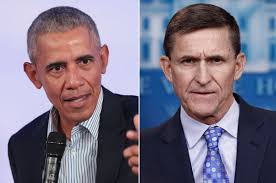
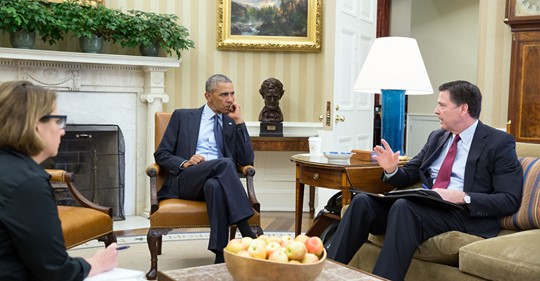
Obama’s recent remarks indicate that the former president needs remedial instruction in the law. Happily, this has now been offered by Sidney Powell, a graduate of the University of North Carolina School of Law and attorney for Gen. Michael Flynn. Will Obama be able to swallow his pride and correct his inaccurate statements about legal precedents regarding Flynn? Or will he let them stand in Nixonian-type variant; as in, “If a (former) president says it’s illegal, that means it’s illegal.”
A crisis of conscience in Vietnam led McGehee to conclude that the agency was “a malevolent force” and to lay it bare in a memoir, “Deadly Deceits.” That memoir of 25 years with the C.I.A. chronicled operations in Southeast Asia and his realization that U.S. efforts in Vietnam were doomed.
Ralph W. McGehee, a veteran of the Central Intelligence Agency’s clandestine crusades in Vietnam who went to war against the C.I.A. itself, died May 2 at an assisted-living facility in Falmouth, Maine. He was 92. The cause was Covid-19, his son, Dan McGehee, said.
Mr. McGehee’s 1983 memoir, “Deadly Deceits,” was a scathing critique, a chronicle of the C.I.A.’s Cold War covert operations in Southeast Asia and his dawning realization that the American cause in Vietnam was doomed. He recalled his epiphany: At the end of 1968, he sat drinking alone in a sparsely furnished villa outside Saigon, listening to a tragic pop song, “The End of the World,” as helicopter gunships circled overhead and B-52s dropped bombs in the distance.
“My idealism, my patriotism, my ambition, my plans to be a good intelligence officer to help my country fight the Communist scourge — what the hell had happened?” he wrote. “Why did we have to bomb the people we were trying to save? Why were we napalming young children? Why did the C.I.A., my employer for 16 years, report lies instead of the truth?” He struggled to answer those questions for the rest of his life.
After growing up on the South Side of Chicago, starring on Notre Dame’s undefeated college football teams from 1946 to 1949, failing a tryout with the Green Bay Packers, and working as a management trainee at Montgomery Ward, he received a telegram from out of the blue in January 1952. It asked: Would you like to serve your country in an unusual way? Football players, given their brawn and affinity for teamwork, were prime candidates for paramilitary missions, in the eyes of the C.I.A.
The Korean War was at its height and the C.I.A., founded in 1947, was expanding exponentially, from 200 officers in the beginning to roughly 15,000 in 1952, with some 50 overseas stations and a budget exceeding $5 billion in today’s money. The agency searched frantically for Americans capable of conducting covert operations overseas.
Mr. McGehee made the grade. After training and indoctrination, the agency sent him out into the world. Serving over the years in Japan, the Philippines, Taiwan, Thailand and South Vietnam, he confronted confounding problems: for example, a richly compensated foreign agent from Taiwan whose highly touted secret reports on Communist China were based on nothing but newspaper clippings. In northern Thailand, he worked on counterinsurgency operations with opium-smoking hill tribesmen, to little avail. He tried, with some success, to train the Thai national police to gather intelligence.
Mr. McGehee rose to the very middle of the C.I.A.’s ranks, and in 1968 he landed in Saigon to work in liaison with the chief of the secret police. He then faced a spiritual crisis. The war was going badly for the United States, and as bad turned to worse, it shattered him. He questioned America’s role in the world, the C.I.A.’s role in Vietnam, his role in the C.I.A., and his very existence. He wrote that he had contemplated unfurling a banner reading “THE C.I.A. LIES” and then killing himself to protest the war.
As a football star at Notre Dame, Mr. McGehee had the kind of talent the C.I.A. was looking for. By 1973, after he returned to headquarters, labeled a malcontent and relegated to a backwater desk, the agency confronted its own existential crisis. The wars of Watergate would breach the ramparts of its secrecy. Cold War skeletons tumbled from the closet: assassination plots, covert support for autocrats, spying on Americans. Presidents had approved such exploits in secret, but the C.I.A. was blamed and shamed. By the time he retired in 1977, Mr. McGehee was convinced that the agency was a malevolent force.
“Deadly Deceits: My 25 Years in the C.I.A.” appeared six years later, after the agency had sought and won significant deletions. Though C.I.A. veterans had published memoirs since the 1960s, few had accused the agency of distorting intelligence to deceive American presidents and the American public to protect its power.
“The American people are the primary target audience of its lies,” Mr. McGehee wrote. Now-declassified Cold War records tell a more complicated story. The C.I.A.’s primary audience was presidents, not the public. Presidents Lyndon B. Johnson and Richard M. Nixon had rejected the C.I.A.’s pessimistic reporting on Vietnam, telling the American people that victory, or peace with honor, was at hand when it wasn’t. The presidents, their national security advisers and the Pentagon had pressured the C.I.A. to confirm their political preconceptions. Sometimes the agency bent to their will, but not often.
Those records do bear out Mr. McGehee’s critique that the C.I.A. had neglected the gathering and analysis of intelligence, its founding mission, in favor of bold covert operations that changed the world, often for the worse, especially in the years leading up to the disastrous Bay of Pigs invasion in Cuba, approved by President John F. Kennedy, in 1961.
Ralph Walter McGehee Jr. was born in Moline, Ill., on April 9, 1928. His parents managed an apartment complex, his mother as a bookkeeper and his father as a maintenance man.
His wife of 63 years, Norma (Galbreath) McGehee, died in 2012. In addition to his son Dan (who is also known as Keenan Dakota), his survivors include another son, Scott; two daughters, Jean Marteski and Peggy McGehee Horton; 10 grandchildren; and four great-grandchildren.
In later years Mr. McGehee developed and maintained CIABASE, an online collection of open-source information, and gave lectures, occasionally laced with conspiracy theories. He once told a reporter for The New York Times that he realized that his book would not change the C.I.A. But, he said, “I guess I justify myself by thinking that I fought for what I thought was right.”
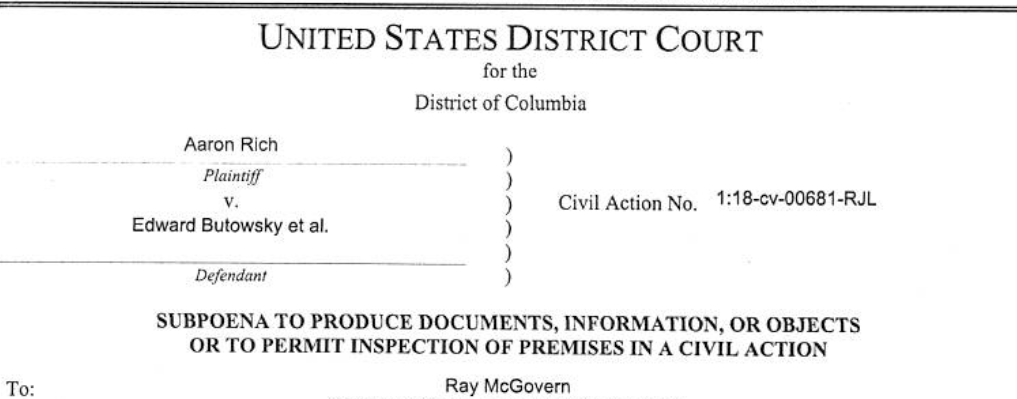
Ray has been asked to post the text of his initial response to Michael J. Gottlieb to the subpoena served to Ray last December, as a new, separate posting sans introduction. For background on Gottlieb, see this short clip in which he and Anderson Cooper discuss “conspiracy theories” about Seth Rich: https://www.youtube.com/watch?v=A9t6zLx6hl8 .
Raymond L. McGovern
Michael J. Gottlieb C/O Graebe Hanna & Sullivan, PLLC 4350 Lassiter at North Hills Ave., Suite 375 Raleigh, NC 27609
Re: Subpoena, Civil Action No. 1:18-cv-00681-RJL Aaron Rich Plaintiff v Edward Butowsky et al.
Dear Mr Gottlieb:
Reference is made to “Document request No. 1,” to wit:
All Documents and Communications, excluding any Documents or Communications that you have published in public sources, relating to claims that (1) the Democratic National Committee was not hacked by the Russians in 2016 or (2) that the Democratic National Committee data was “leaked” and not “hacked,” including but not limited to claims made in memos by members of the Veteran Intelligence Professionals for Sanity (“VIPS”) found on line at
It is gratifying to see the subpoena highlight three of the key Veteran Intelligence Professionals for Sanity (VIPS) Memoranda for the President (two to Barack Obama and one to Donald Trump), in which we applied the principles of physics and forensic science to show that the DNC emails were leakedin spring 2016 — not given to WikiLeaks via a hack by Russia or by anyone else. For the past three years, we have been trying to call attention to those findings.
I would call particular attention to the second referenced Memoranda (the one addressed to President Obama on January 17, 2017 entitled “A Key Issue [namely, Russian ‘hacking’ given to WikiLeaks] That Still Needs to be Resolved”). The following day Obama actually addressed that issue at a press conference, when he conceded that the intelligence community had no idea how the DNC emails reached WikiLeaks.
Although Obama was thoroughly briefed less than two weeks before by the rump intelligence-community trio of James Comey, John Brennan, and James Clapper, Obama was not buying their “Russian-hack-to-WikiLeaks” high-confidence assessment. At a public meeting on November 13, 2018, I asked James Clapper why his then-boss saw fit to call the trio’s “conclusions” on that key issue “inconclusive.” Clapper replied: “I can’t explain what he [Obama] said or why. But I can tell you we’re, we’re pretty sure we know, or knew at the time, how WikiLeaks got those emails.”
Pretty sure? Someone should ask Obama why he injected his surprising disclaimer into that press conference two days before he left town.
Also worthy of note is that, in our Memorandum to President Obama of December 12, 2016 entitled “Allegations of Hacking Election Are Baseless,” we told him that the evidence we already had could save Congress from “partisanship, expense, and unnecessary delay.” That time, the president chose not to listen.
President Trump, on the other hand, apparently was listening to what we told him in the third Memorandum cited in the subpoena — “Was the Russian ‘Hack’ an Inside Job?” (July 24, 2017). We told him this:
The January 6 [2017] “Intelligence Community Assessment” by “hand-picked” analysts from the FBI, CIA, and NSA seems to fit into the same agenda-driven category. It is largely based on an “assessment,” not supported by any apparent evidence, that a shadowy entity with the moniker “Guccifer 2.0” hacked the DNC on behalf of Russian intelligence and gave DNC emails to WikiLeaks.
The recent forensic findings mentioned above have put a huge dent in that assessment and cast serious doubt on the underpinnings of the extraordinarily successful campaign to blame the Russian government for hacking. …
You may wish to ask CIA Director Mike Pompeo what he knows about this. Our own lengthy intelligence community experience suggests that it is possible that neither former CIA Director John Brennan, nor the cyber-warriors who worked for him, have been completely candid with their new director regarding how this all went down.
We were gratified when the President ordered then-CIA Director Mike Pompeo to invite Bill Binney to CIA Headquarters to brief him on our findings. Binney did so on October 24, 2017 with his typically no-holds-barred explanation of our findings and of how Pompeo’s subordinates were being less than candid. There is no sign, however, that Pompeo followed up — by pursuing the matter with his own analysts, or by giving President Trump a report on the Binney-Pompeo meeting.
Our findings are a matter of public record, as is the evidence we adduce to support those findings. My colleagues Bill Binney, Ed Loomis, and Skip Folden tell me they have already provided tons of material in response to subpoenas like the one I received more recently than they did. Since all of my relevant email correspondence included at least one of those three colleagues, you already are in possession of what you ask from me.
It is true that I cannot be sure that my colleagues have included — as required by the subpoena — all their “comments, ‘likes’, ‘shares’, direct messages, all Social Media activity.” In any case, please be assured that I have never “liked” or “shared” or direct messaged.
That should take care of “Document request No. 1.”
I infer that plaintiff Aaron Rich, having read the three VIPS memos mentioned in the subpoena, has become convinced that the evidence that Russia was responsible for intruding into the DNC and giving the emails to WikiLeaks is spurious; that someone may have thought that Aaron’s brother Seth had something to do with how WikiLeaks got the emails; and that this may account for why Seth was murdered. I applaud Aaron’s apparent interest in putting the Russian story in the category of not-supported-by-evidence and assume he will redouble his efforts to find out who killed his brother.
Please pass along this one suggestion to Aaron: He might consider trying to pry loose Seth’s computer which reportedly is in the hands of the FBI. Department of Justice Michael Horowitz’s recent findings show that the FBI has long had a dog in this fight and has made many “mistakes” — all of them in support of that canine. In recent days, even Attorney General William Barr has made clear his distrust of ex-FBI Director James Comey. In conveying this to Aaron, please also ensure that he receives the following list of links to supplemental reading. And please consider this responsive to “Document Request No. 2” —“All documents and Communications relating to any member of the Rich family.”
Last, let me express my personal solidarity with Aaron Rich in his search to find out who killed Seth, and wish him success. Aaron’s effort strikes me not only as exemplary, but in close keeping with the biblical mandate to be “my brother’s keeper.”
While the three VIPS memos cited in the subpoena are well chosen as reference points, I list below, as a courtesy, additional links to relevant articles for further background. Most of them shed light on the analysis VIPS has been devoting to this issue — for three years now, and counting.
Links to Further Information/Analysis (Listed in Chronological Order): Particular attention is directed toward the last entry, which links to a detailed technical study just completed regarding “Guccifer 2.0.”
As readers of Consortium News and of raymcgovern.com know, VIPS has been poking forks into the red herring of “Russian pre-2016-election hacking of the DNC emails” for three and a half years. In the process, we have called attention to the tarnished reputation of CrowdStrike, a viscerally anti-Russian cyber-security firm that has had to retract erroneous forensic findings in the past. We have also noted that, like former British intelligence sleuth Christopher Steele, CrowdStrike was paid by the Democrats; and that, instead of ordering the FBI to investigate, Comey chose to defer to CrowdStrike to look into the alleged Russian “hack”.
Tucker Carlson “Gets It”
Our conclusions have made us lepers — not to be touched by “respectable” mainstream media — at least until Tucker Carlson had the courage to look into it, and — to his credit — not for the first time. His Friday evening comments are instructive ( https://www.youtube.com/watch?v=Imhbncy9RJg&t=304s ).
Consortium News editor’s caution was understandable, given the predictable cognitive dissonance would greet any additional proof that “what everybody believes” about Russian-hacking of the DNC has been a lie. Thus, my article was given an understated title: “New House Documents Sow Further Doubt That Russia Hacked the DNC.”
“Russia-gate: Can You Handle the Truth?” is title I gave to a talk I gave to a progressive audience in Seattle on August 4, 2018. ( See: https://www.youtube.com/watch?v=ngIKjpucQh8 — with 222,000 views.). It turned out that most of them could not handle it. I should not have been surprised. Far too many who still believe that the NY Times still publishes “all the news that’s fit to print” will refuse to face the newly revealed facts pouring out of the freshly disclosed testimony of the 53 witnesses called by House Intelligence Committee Adam Schiff and then covered up by him until last Thursday.
Intelligence Analysis vs. Punditry
It seems impossible for many people to understand the truth-in-advertising-type notice that VIPS was careful to place in the text of its key Memorandum For the President of July 24, 2017. Intel Vets Challenge ‘Russia Hack’ Evidence, ( https://consortiumnews.com/2017/07/24/intel-vets-challenge-russia-hack-evidence/ ). We gave it the college try to help readers appreciate the difference between honest intelligence analysis by former practitioners and talking heads. Here’s what we included in our Memorandum to the President:
“Full Disclosure: Over recent decades the ethos of our intelligence profession has eroded in the public mind to the point that agenda-free analysis is deemed well nigh impossible. Thus, we add this disclaimer, which applies to everything we in VIPS say and do: We have no political agenda; our sole purpose is to spread truth around and, when necessary, hold to account our former intelligence colleagues.
“We speak and write without fear or favor. Consequently, any resemblance between what we say and what presidents, politicians and pundits say is purely coincidental. The fact we find it is necessary to include that reminder speaks volumes about these highly politicized times.”
Subpoena Envy
So if the Russians did not give the DNC emails to WikiLeaks, who did? There is a relatively well known candidate, but mentioning his or his brother’s name can get you sued by a family with apparently unlimited funds to pay lawyers close to the Democratic party. Go figure.
Starting late last year, several VIPS members were served highly intrusive subpoenas on the Russian hacking issue. I shall confess that, for a couple of months I had a touch of subpoena envy. Then, alas, I was served — two subpoenas so far. In my initial response last December to the first subpoena, I took some pains to lay out, as concisely as I could, what VIPS believes and why. And I added enough links to help anyone seriously interested in learning the longer story. Readers may wish to skim through my response, which follows:
++++++++++++++++++++++
Raymond L. McGovern
Michael J. Gottlieb C/O Graebe Hanna & Sullivan, PLLC 4350 Lassiter at North Hills Ave., Suite 375 Raleigh, NC 27609
Re: Subpoena, Civil Action No. 1:18-cv-00681-RJL Aaron Rich Plaintiff v Edward Butowsky et al.
Dear Mr Gottlieb:
Reference is made to “Document request No. 1,” to wit:
All Documents and Communications, excluding any Documents or Communications that you have published in public sources, relating to claims that (1) the Democratic National Committee was not hacked by the Russians in 2016 or (2) that the Democratic National Committee data was “leaked” and not “hacked,” including but not limited to claims made in memos by members of the Veteran Intelligence Professionals for Sanity (“VIPS”) found on line at
It is gratifying to see the subpoena highlight three of the key Veteran Intelligence Professionals for Sanity (VIPS) Memoranda for the President (two to Barack Obama and one to Donald Trump), in which we applied the principles of physics and forensic science to show that the DNC emails were leakedin spring 2016 — not given to WikiLeaks via a hack by Russia or by anyone else. For the past three years, we have been trying to call attention to those findings.
I would call particular attention to the second referenced Memoranda (the one addressed to President Obama on January 17, 2017 entitled “A Key Issue [namely, Russian ‘hacking’ given to WikiLeaks] That Still Needs to be Resolved”). The following day Obama actually addressed that issue at a press conference, when he conceded that the intelligence community had no idea how the DNC emails reached WikiLeaks.
Although Obama was thoroughly briefed less than two weeks before by the rump intelligence-community trio of James Comey, John Brennan, and James Clapper, Obama was not buying their “Russian-hack-to-WikiLeaks” high-confidence assessment. At a public meeting on November 13, 2018, I asked James Clapper why his then-boss saw fit to call the trio’s “conclusions” on that key issue “inconclusive.” Clapper replied: “I can’t explain what he [Obama] said or why. But I can tell you we’re, we’re pretty sure we know, or knew at the time, how WikiLeaks got those emails.”
Pretty sure? Someone should ask Obama why he injected his surprising disclaimer into that press conference two days before he left town.
Also worthy of note is that, in our Memorandum to President Obama of December 12, 2016 entitled “Allegations of Hacking Election Are Baseless,” we told him that the evidence we already had could save Congress from “partisanship, expense, and unnecessary delay.” That time, the president chose not to listen.
President Trump, on the other hand, apparently was listening to what we told him in the third Memorandum cited in the subpoena — “Was the Russian ‘Hack’ an Inside Job?” (July 24, 2017). We told him this:
The January 6 [2017] “Intelligence Community Assessment” by “hand-picked” analysts from the FBI, CIA, and NSA seems to fit into the same agenda-driven category. It is largely based on an “assessment,” not supported by any apparent evidence, that a shadowy entity with the moniker “Guccifer 2.0” hacked the DNC on behalf of Russian intelligence and gave DNC emails to WikiLeaks.
The recent forensic findings mentioned above have put a huge dent in that assessment and cast serious doubt on the underpinnings of the extraordinarily successful campaign to blame the Russian government for hacking. …
You may wish to ask CIA Director Mike Pompeo what he knows about this. Our own lengthy intelligence community experience suggests that it is possible that neither former CIA Director John Brennan, nor the cyber-warriors who worked for him, have been completely candid with their new director regarding how this all went down.
We were gratified when the President ordered then-CIA Director Mike Pompeo to invite Bill Binney to CIA Headquarters to brief him on our findings. Binney did so on October 24, 2017 with his typically no-holds-barred explanation of our findings and of how Pompeo’s subordinates were being less than candid. There is no sign, however, that Pompeo followed up — by pursuing the matter with his own analysts, or by giving President Trump a report on the Binney-Pompeo meeting.
Our findings are a matter of public record, as is the evidence we adduce to support those findings. My colleagues Bill Binney, Ed Loomis, and Skip Folden tell me they have already provided tons of material in response to subpoenas like the one I received more recently than they did. Since all of my relevant email correspondence included at least one of those three colleagues, you already are in possession of what you ask from me.
It is true that I cannot be sure that my colleagues have included — as required by the subpoena — all their “comments, ‘likes’, ‘shares’, direct messages, all Social Media activity.” In any case, please be assured that I have never “liked” or “shared” or direct messaged.
That should take care of “Document request No. 1.”
I infer that plaintiff Aaron Rich, having read the three VIPS memos mentioned in the subpoena, has become convinced that the evidence that Russia was responsible for intruding into the DNC and giving the emails to WikiLeaks is spurious; that someone may have thought that Aaron’s brother Seth had something to do with how WikiLeaks got the emails; and that this may account for why Seth was murdered. I applaud Aaron’s apparent interest in putting the Russian story in the category of not-supported-by-evidence and assume he will redouble his efforts to find out who killed his brother.
Please pass along this one suggestion to Aaron: He might consider trying to pry loose Seth’s computer which reportedly is in the hands of the FBI. Department of Justice Michael Horowitz’s recent findings show that the FBI has long had a dog in this fight and has made many “mistakes” — all of them in support of that canine. In recent days, even Attorney General William Barr has made clear his distrust of ex-FBI Director James Comey. In conveying this to Aaron, please also ensure that he receives the following list of links to supplemental reading. And please consider this responsive to “Document Request No. 2” —“All documents and Communications relating to any member of the Rich family.”
Last, let me express my personal solidarity with Aaron Rich in his search to find out who killed Seth, and wish him success. Aaron’s effort strikes me not only as exemplary, but in close keeping with the biblical mandate to be “my brother’s keeper.”
While the three VIPS memos cited in the subpoena are well chosen as reference points, I list below, as a courtesy, additional links to relevant articles for further background. Most of them shed light on the analysis VIPS has been devoting to this issue — for three years now, and counting.
Links to Further Information/Analysis (Listed in Chronological Order): Particular attention is directed toward the last entry, which links to a detailed technical study just completed regarding “Guccifer 2.0.”
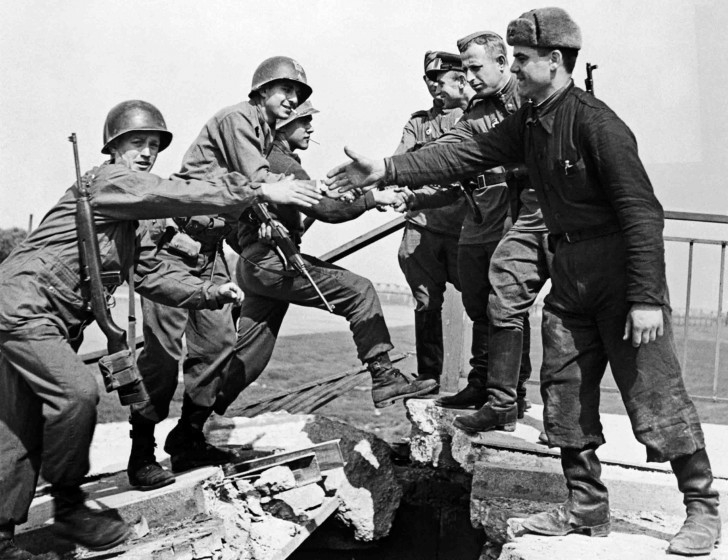
As the 75th anniversary of World War II’s end is celebrated today, few Americans know of the Soviet Union’s major role in that victory, making them more susceptible to viral political infections like “Russia-gate”. These two articles fall short of a vaccine to prevent wacky “all-roads-lead-to-Putin”-style gems by the likes of Nancy Pelosi-McCarthy. We simply offer them as a needed historical corrective — an easily administered antidote to help counteract deeply ensconced anti-Russian poison, while we work on a vaccine.
2 — ‘Obama’s Self-Deceit’ [or ‘Exceptionalism: Giving Hypocrisy a Bad Name’] By Joe Lauria, Sept. 29, 2015 (republished May 8, 2020) https://consortiumnews.com/2020/05/08/25-years-of-cn-obamas-self-deceit-sept-29-2015/ Five years ago at the UN, President Obama, who had boasted earlier of ordering military strikes on seven countries, chastised Russia and China for not abiding by the rules of international behavior.
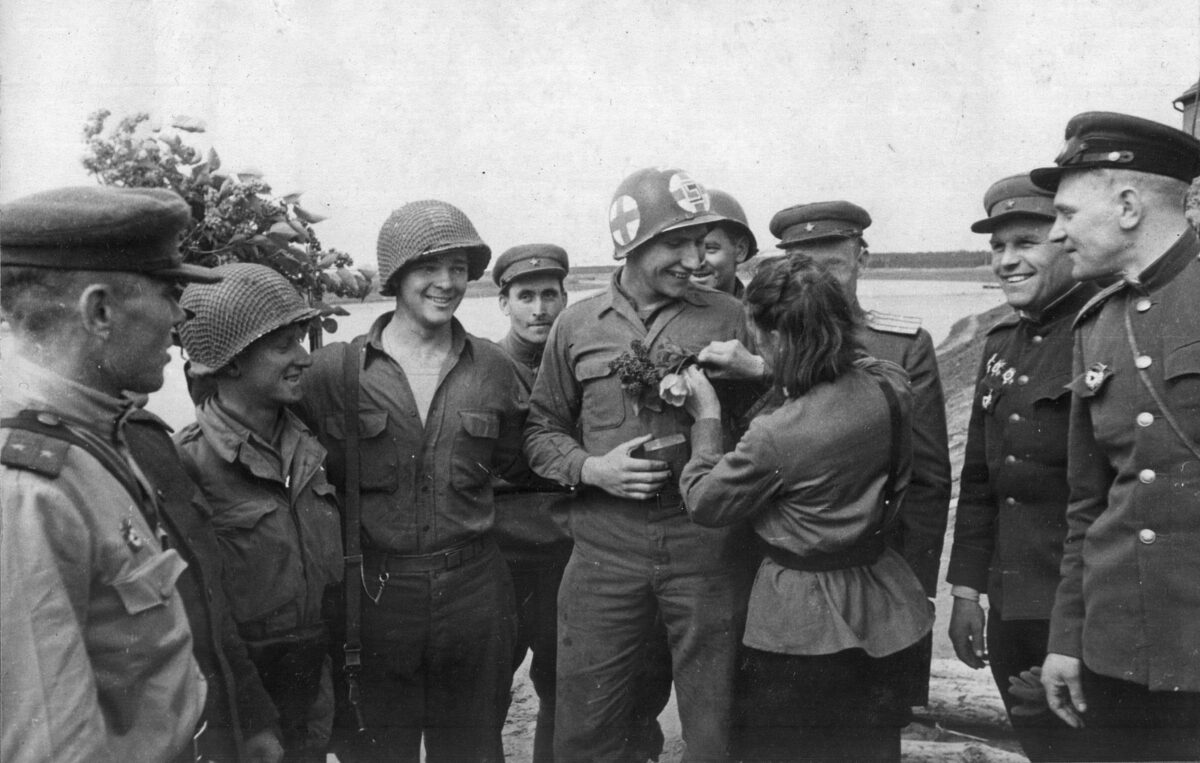
Soviet nurse Lyubov Kozinchenko gives flowers to the American military physician Carl Robinson, Elbe River, Germany, 25th April, 1945
(Edited by Ray McGovern)
Last June Scott Ritter wrote an instructive review of key aspects of WWII, “What Russia Rightfully Remembers, America Forgets” ( See: https://www.truthdig.com/articles/what-russia-rightfully-remembers-america-forgets/ ). Scott’s fellow Veteran Intelligence Professionals for Sanity (VIPS) were asked to comment on his article and an informal colloquy emerged – primarily between Scott and Larry Wilkerson.
Looking toward the 75th anniversary of VE Day Friday, I have the dubious distinction of remembering that glorious day as a 5 year-old). I am grateful to be still around and happy to have the opportunity to offer below the fact-based views of younger esteemed colleagues, who have grappled long and hard with political-military issues of this kind – both as historians and as practitioners. I have slightly condensed their prose.
+++++++++++++++++++
From “What Russia Rightfully Remembers, America Forgets” Scott Ritter, June 26, 2019
On June 6, 2019 President Trump commemorated the 75th Anniversary of Operation Overlord, popularly known as D-Day, when approximately 160,000 U.S., British, Canadian and Free French soldiers landed in and around the beaches of Normandy, France. Speaking at the Normandy American Cemetery and Memorial in Colleville-sur-Mer, where the remains of 9,388 American fighting men, most of whom perished on D-Day, are interned, Trump promoted the mythology of American omniscience that was born on the beaches of Normandy. …
For Americans, D-Day stands out among all others when it comes to celebrating the Second World War. Immortalized in books, a movie starring John Wayne, and in the HBO series titled “Band of Brothers,” the landings at Normandy represent to most Americans the turning point in the war against Hitler’s Germany, the moment when the American Army (together with the British, Canadian and Free French) established a foothold in occupied France that eventually led to the defeat of Germany’s army.
What Trump overlooked in his presentation was the reality that the liberation of Europe began long before the D-Day landings. And the burden had almost exclusively been born by the Soviets … his speech was simply the latest in a series of historically flawed remarks delivered by a succession of American presidents ever since they began giving speeches at Normandy in commemoration of D-Day. President George W. Bush’s address on the 60th anniversary of the D-Day landings was typical of the genre, maximizing American glory while ignoring that of the Soviets. … Bush: Our GIs had a saying: ‘The only way home is through Berlin.’ That road to VE-Day was hard and long. …. And history will always record where that road began. It began here, with the first footprints on the beaches of Normandy.”
But Bush was wrong; the road to Berlin had its origins at the approaches to Moscow, where the Soviet army turned back German invaders in December 1941. It was paved at Stalingrad in 1942 with the blood and flesh of 500,000 dead Soviet soldiers, who had killed more than 850,000 Nazi soldiers and their allies; and it was furthered in the bloody fields of Kursk, in 1943, where at the cost of more than 250,000 dead and 6,000 tanks destroyed, the Soviet army defeated the last major German offensive on the Eastern front … The Russians destroyed more than 40,000 German tanks from June 1941 to November 1944. By the time the U.S., British, Canadian and Free French forces came ashore at Normandy, the Germans had already lost the war. …
It was as if the road to Berlin had ended with Americans capturing the Nazi capital, compelling Adolf Hitler to commit suicide …. But that honor fell to the Soviets, who, in a two-week campaign, lost more than 81,000 killed and a quarter of a million men wounded seizing Berlin from fanatical Nazi defenders. …
The German Attack
On June 22, 1941, the Soviet Union was attacked by Nazi Germany. Some 3.8 million Axis soldiers, backed by more than 6,000 armored vehicles and 4,000 aircraft, launched a surprise attack along a continuous front that ran from the Baltic Sea in the north to the Black Sea in the south. Known as Operation Barbarossa, the German offensive decimated the defending Soviet forces, breaking through the front lines and driving deep into Soviet territory, initiating a conflict that would last nearly four years. During that time, more than 26 million Soviet citizens would die, including 8.6 million soldiers of the Red Army (these are conservative numbers—some estimates, drawing upon classified information, hint that the actual number of total deaths might exceed 40 million, including more than 19 million military deaths). [In contrast, the U.S. military killed or MIA in both the European and Pacific theaters numbered about 407,000 – less that 5 percent of Soviet losses.]
The traumatic impact of what became known in the Soviet Union as the Great Patriotic War cannot be overstated. The complete devastation of entire regions at the hands of the invading Germans is something Americans never have experienced, and as such can never comprehend. …
Bogged Down in the West; Relentless Attack From the East
While the landing at Normandy had gone well, the advance inland was a different matter. By June 23, 1941—a mere 17 days after the D-Day landings—the U.S. and U.K. forces were stuck in ferocious fighting with German troops dug in behind thick hedgerows that made movement of men and armored vehicles virtually impossible. The port of Cherbourg was still in German hands, which meant that desperately needed supplies were not getting to the troops doing the fighting and dying. Any serious reinforcement of the German position in France would have made the allied beachhead tenuous.
But there wouldn’t be any German troops moving into France, for the simple reason that they were all tied down fighting a life-or-death struggle on the Eastern front, trying to cope with a massive Soviet offensive known as Operation Bagration … [that] made anything taking place in France pale by comparison. [Operation Bagration was named after a Tsarist general who had fought Napoleon.]
By the time Operation Bagration ground to a halt, in mid-August 1944, some 400,000 German soldiers from Army Group Center—the most highly trained, experienced men in the German army—were either dead, wounded or taken prisoner, and some 1,350 tanks destroyed. The Soviet offensive tore a gigantic hole in the German lines that had to be filled with troops and material that otherwise would have been available to contain the Normandy landings. The cost of this victory, however, was staggering—180,000 Soviet dead and 590,00 wounded, matching in a span of two months the total casualties suffered by the U.S. in the entire European theater of operations, including North Africa, from 1942 to 1945. …
Operation Bagration saved D-Day, but you won’t hear any American presidents acknowledging that fact. Nor will any Americans pause and give thanks for the sacrifice of so many Soviet lives in the cause of defeating Nazi Germany. Let there be no doubt that the United States played an instrumental role in the defeat of Hitler—we were the arsenal of democracy, and our lend-lease support to the Soviet Union was critical in the success of the Soviet army.
But the simple fact is that we never faced the German A-team—those men had perished long ago on the Eastern front, fighting the Soviets. The German army we faced was an amalgam of old men, young boys, unmotivated foreigners (including thousands of captured Russian and Poles), and worn-out, wounded survivors of the fighting in the east. We beat the Germans, but because of the pressure brought to bear on Germany by the Soviet Union, the outcome in Western Europe was never in doubt.
Why does this matter? Because facts matter. History matters. The hubris and arrogance derived from our one-sided, exaggerated and highly inaccurate version of the Second World War … It gives total disregard for any Russian perspective regarding the future of a continent the Soviets liberated through the blood and sacrifice of tens of millions of their citizens. While we Americans continue to celebrate a version of events that is highly fictionalized, the Russians commemorate a reality anchored in fact. … There will come a time when fiction-based arrogance will clash with fact-based realism. If history tells us anything, those who more accurately remember the lessons of the past will fare far better than those who, by their ignorance, are condemned to repeat their mistakes.
+++++++++++++
Comments of Larry Wilkerson
It’s all well and good to correct historical perceptions that are dead wrong. … However, any such “correction” ought to at least touch upon the full story, not just parts of it.
The true U.S. strategy in WWII, summed up in George Marshall-like terms, was to become the arsenal of democracy, though of course that’s a misnomer, because those for whom we were the almost existential arsenal were the Soviets, certainly no democracy.
Marshall knew we were not the best soldiers on earth, not by a long shot. So how to win a global struggle against those who clearly were, the Wehrmacht? Marshall knew that what we did do better than anyone else on earth was produce things. So, the “dollar men”. The invention of the Military-Industrial Complex (MIC). The turning of the most massive productive capacity in human history, to war production. That’s what we did.
We supplied the Soviets through Iran (840,000 wheeled vehicles, for example) and through Murmansk. Without the Iran link (actually put in motion BEFORE U.S. entry into WWII in December 1941), Stalingrad would never have been defended successfully. Paulus 6th Army would have won and got to the oil Germany coveted. In short, without the U.S.-established LOCs (lines of communication [and supply]) through Iran and Murmansk, the Soviets would have lost badly.
I used to show my students a grainy, black-and-white video clip of a Russian regimental commander entering Berlin. Close-up on the vehicle in which he was riding: “FORD”. We need to tell the complete story.
+++++++++++++++
Scott Ritter Response
Having spent my life studying the Red/Soviet/Russian military from both the perspective of a historian (my honors thesis dealt with the doctrinal links between the Tsarist military and the Soviets) and a professional preparing to face them on the field of battle, I try to take a responsible fact-based position when writing on any topic that touches the subject. I’ve read extensively on the Eastern Front, and am particular indebted to both John Erickson’s Road to Stalingrad/Road to Berlin, and David Glantz’s When Titans Clashed. Both speak of the tremendous contribution made by Lend Lease to the Soviet war effort, but neither give the US/UK aid program war-winning status.
Glantz in particular addresses the question head on, writing “If the Western Allies had not provided equipment and invaded Northwest Europe, Stalin and his commanders might have taken twelve to eighteen months longer to finish off the Wehrmacht. The result would probably have been the same, except that Soviet soldiers would have waded at France’s Atlantic beaches rather than meeting the Allies at the Elbe.”
I don’t diminish the role played by the US, but my reading of history shows that Gen. Paulus had lost at Stalingrad well before that battle ever began, with the German’s having been exhausted in the brutal winter fighting of 1941-42.
I stand by everything I wrote about the role played by the Soviets in defeating Nazi Germany.
+++++++++++++++++++++
Response from Larry Wilkerson
And I stand by all that I said about the US employing its awesome productive capacity to aid the British, the Free French, the Russians, other lesser “allies”, and itself in an unprecedented way, while waging war on two major fronts, the European and the Pacific (it’s what got us the military-industrial complex, sad to say). There have been few really delving studies of this because logistics is not sexy.
Just as Parmenion made Alexander the Great great (see The Logistics of the Macedonian Army), so U.S. productive capacity “won” WWII. Admittedly, a lot of dead and living Soviet soldiers–and partisans from Stalingrad to Kiev, as well as German high-command mistakes–helped majorly, as did the rugged T-34 tank (particularly at Kursk where battle-sight zero was twenty feet most of the time and tankers whom I have interviewed personally, from both sides, lost their hearing permanently due to the incredible noise of so many tank guns operating simultaneously).
Anyone who’s read Guy Sajer’s The Forgotten Soldier (the All Quiet on the Western Front of WWII) knows what the Soviet contribution was and it was, in a word, awesome. Logistics, aside from not being sexy, is always underreported, underplayed, and rarely given its due. It’s the nature of the beast, particularly for Americans who are raised by Hollywood as much as by any biological parents.