
The Kremlin, Moscow
Vladimir Putin answered questions from media representatives.
President of Russia Vladimir Putin: Good evening. Happy holiday once again, happy Victory Day.
UKRAINE
FIRST QUESTION:
… US President Donald Trump came up with an initiative to declare a three-day ceasefire. You supported it, so did Zelensky. However, on the eve of May 9, there were still a number of grave and provocative statements coming from Kiev. … Were there any provocations?
Vladimir Putin: As for provocations, as you can see, I am here … As for the provocative statements, we responded to them; we said we would respond with massive missile strikes on Kiev. Was there anything unclear about it? … But we did not stop there.
We started working with our major partners and friends, primarily with our friends from China, India and some other nations, including with the US administration. We noted that the command and decision-making centers in Kiev are located in close proximity to the diplomatic missions of many countries – several dozen, in fact.
When we began this dialogue with the US administration, we drew their attention to this matter and outlined the potential consequences. As a result of all these discussions, US President Donald Trump proposed an additional two-day ceasefire and a prisoner exchange during that period.
We immediately agreed to this proposal, particularly because, in my view, it was fully justified, motivated by respect for our shared victory over Nazism, and clearly humanitarian in nature.
++++++++++++++++++++++++++
THE FOLLOWING IS A KEY QUESTION; ZARUBIN IS SAID TO BE PUTIN’S FAVORITE JOURNALIST [RLM]
QUESTION: Pavel Zarubin: Good evening. Pavel Zarubin, Rossiya Channel.
… I can’t help but ask this question. You have recently said that the terrorist threat is growing, meaning the Kiev regime. We can see that such strikes are targeting cities located far away from the border, such as Yekaterinburg, Perm, and recently, Cheboksary. Is the West going too far? The West has admitted that the Kiev regime would not have survived several days without its support.
Vladimir Putin: What exactly is the West? I believe that it is the so-called globalist part of the Western elites. It is them who are fighting against us by proxy of Ukraine. They had no regard for Russia’s interests whatsoever.
Moreover, seeking to use Ukraine as an instrument for attaining their geopolitical goals, these people in the West lied to everyone, as they have now openly admitted. They started to lie to us about the non-expansion of NATO to the east at the beginning of the 1990s. They told us that NATO would not move a single step eastward. Well, where are they now? Taken together, all this has provoked the current situation
We have recently discussed this issue with our colleagues, remembering how it all started. We concluded an agreement with the Ukrainians and initialed it in Istanbul in 2022. And then one of my colleagues – frankly, it was Macron who did it – called me and said, “Ukraine cannot sign such documents with a gun to its head.” This is a direct quote; we have the tape of that conversation. I asked him, “What should we do?” He said, “Can you withdraw troops from Kiev?” We did it.
Then a member of show business popped up, the then Prime Minister of Britain. He said that the agreement cannot be signed because it is unfair. Who says what is fair and what is not? Why is it unfair if the head of the Ukrainian negotiating team has initialed the document? Who is the judge?
Next, they promised assistance [to Ukraine] and started fostering confrontation with Russia, which is continuing to this day. I believe that the matter is coming to an end, but this is really a serious matter.
There are certainly clever people over there, those who certainly understand the essence of the current events. I hope that these political forces will gradually return to power or will take power into their own hands with support from the overwhelming majority of European countries.
++++++++++++++++++++++++++++
QUESTION:
In view of what you have said about negotiations, what do you think, in general, about continuing to work with the Americans on the settlement of the Ukraine conflict? The pause has been protracted; the last round of talks took place in winter. Given that Rubio said that maybe it is not worth investing time in it at all.
Vladimir Putin: Listen, this primarily concerns Russia and Ukraine. If someone wants to help us and is doing so, and we can see that the current US Administration and the US President are sincerely, I want to emphasise it, seeking a settlement – they obviously have no need for this conflict, and have many other priorities – then we can only be thankful to them. However, this is, above all, a matter for Russia and Ukraine.
++++++++++++++++++++++
QUESTION:
Who would you personally prefer for negotiations? Do you think there are still pragmatic politicians left in Western Europe with whom dialogue is possible?
Vladimir Putin: Personally, I would prefer former German Chancellor Gerhard Schroeder. Otherwise, Europeans should choose a leader they trust, someone who has not badmouthed Russia.
++++++++++++++++++++++
++++++++++++++++++++++
IRAN
THIS BELOW IS HIGHLY INTERESTING; SHOWS HOW SERIOUS PUTIN IS ABOUT OFFERING RUSSIA’S GOOD SERVICES, AS IT DID WITH THE JCPOA.
QUESTION: Hassan Nassr, RT Arabic.
Mr President, I would like to return to the issue of the developments in the Persian Gulf. One of the strict demands the United States continues to insist upon is the removal of highly enriched uranium.
Russia previously offered its own territory as a site for that transfer, but the United States keeps rejecting the proposal. At the same time, Iran has stated that it wants to retain the uranium. Under these circumstances, what solution do you see to this deadlock?
Vladimir Putin: You know, I will let you in on something, although it is not much of a secret really.
Not only did we make such an offer; we already implemented it once before, back in 2015. Iran has complete trust in us, and not without reason. First, we have never violated any agreements, and second, we continue to cooperate with Iran on peaceful nuclear energy programmes. We built the Bushehr [nuclear power plant], which is now operational, and we are carrying on with our work there. Our cooperation in the field of peaceful nuclear energy continues regardless of the current developments.
So, we already carried out this arrangement in 2015, and it became the foundation for the agreement reached between Iran and all the interested parties, playing a highly constructive role. We therefore have practical experience in this matter, and as I have already mentioned, we remain ready to do it again.
At the outset – and this is somewhat sensitive information – everyone agreed to the idea: representatives of the United States agreed, as did Iran and Israel. However, later the United States toughened its stance, insisting that the materials be transferred exclusively to its territory. In response, Iran also hardened its own position. Mr Ali Larijani visited [Russia]. Sadly, he has since passed away, which is a great loss. He was someone with whom it was possible to have a constructive dialogue; he listened carefully, and responded thoughtfully. So back then, he arrived and said: “You know, we have revised our position as well. We are no longer prepared to export this enriched uranium anywhere. Instead, we are proposing a new format of cooperation with Russia – establishing a joint venture on the Iranian territory and jointly diluting the uranium there.”
I replied: “Okay, that is acceptable to us. The most important thing is reducing tensions.” But I also said that I doubted anyone else – neither the United States nor Israel – would agree to such a proposal. And that is what happened. Frankly speaking, the situation in this area has now reached an impasse.
Our proposals remain on the table, and I believe they are reasonable. Why? First, if everyone agrees to them, Iran could feel fully confident that the materials will be transferred to a friendly country – one that cooperates with Iran and intends to continue cooperating in the peaceful use of nuclear energy. Iran has repeatedly stated that it has no ambitions related to nuclear weapons or other military nuclear programmes. There is also the fatwa issued by the previous Iranian supreme leader, and we have heard repeated public statements on this matter. Moreover, the IAEA has never stated that it possesses evidence showing Iran is pursuing nuclear weapons. At the same time, I believe the other participants in the process could also be interested in such a solution and find it acceptable.
First, everyone would know exactly what materials exist, in what quantity, and where they are located. Second, everything would remain under IAEA supervision. And finally, the process of diluting the uranium would also take place under IAEA oversight, in a transparent and safe manner. For our part, we do not need anything from this. At the same time, we don’t need anything merely to, excuse the expression, flex political muscle and claim that nothing can be done without us. We simply want to make our fair share of contribution acceptable to all sides toward easing tensions.
And if this proposal does not suit everyone, then so be it. In any case, we will support any arrangement or solution that helps break the deadlock and opens the path toward a peaceful settlement. I also believe there are still nuances and areas where compromise is possible, although I will not go into those details right now.
+++++++++++++++++++++++
QUESTION:
Olga Volkova, RIA Novosti.
Given the current sentiment in the West, do you think this trend will intensify? Is there anything Russia can do in response?
Vladimir Putin: The stronger Russia becomes, the sooner all of this will begin to fade. That is the first point.
Second, why is this happening at all? In my view, this is, oddly enough, a form of revanchism on the part of the same globalist Western elites I have mentioned earlier.
What do I mean by that? As I have already said – and we all are aware of this – everyone expected Russia to collapse quickly. In their view, within six months everything would have supposedly fallen apart.
Why did Finland join NATO? Did we have any territorial disputes with Finland? No. All such issues had long been resolved. Nothing further was needed, and the Finnish leadership was perfectly aware of that. So why did they join NATO? Because they expected everything here to collapse – and they would be quick to snap that up.
Now they are already constructing a border fence along the Sestra River. I could make a certain gesture or comment about it, but since I come from the cultural capital, I will restrain myself. In many ways, I believe what we are witnessing is driven precisely by this type of thinking.
But now people are beginning to understand that the situation is not so simple and that serious challenges have emerged, and those are not easy to overcome. It would be wiser to look for ways to restore normal relations and move toward mutually acceptable agreements.
For our part, we have always tried to build relations with Europe on the basis of mutual respect and consideration of each other’s interests. These are not merely diplomatic clichés – that is genuinely how we approached our relations. Even now, not everyone speaks to Europe in that manner, but we always did. Yet apparently that was not enough.
I hope the understanding that this approach was mistaken is already beginning to emerge and will continue to grow stronger. And I hope that relations will eventually be restored with many of the countries that are currently attempting to denounce us. The sooner that happens, the better it will be for us and, in this case, for the European countries.
END OF EXCERPTS
FROM: http://en.kremlin.ru/events/president/news/79718
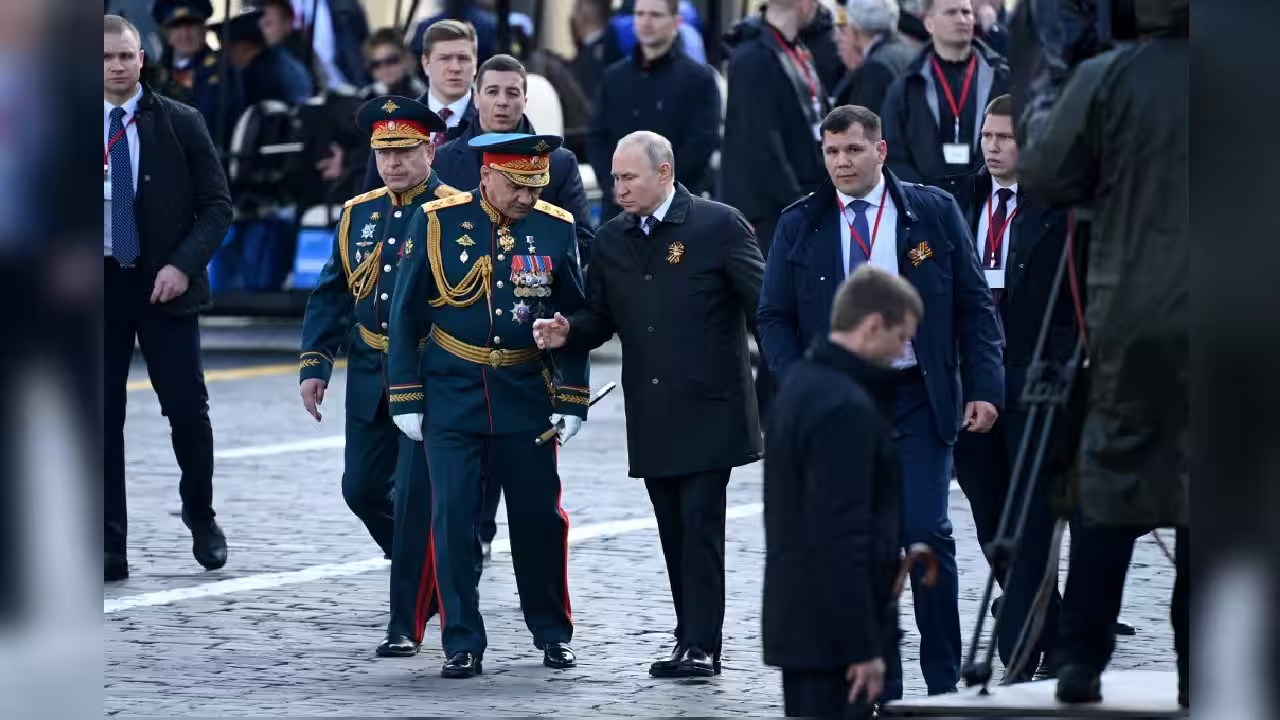
(Image: AFP)